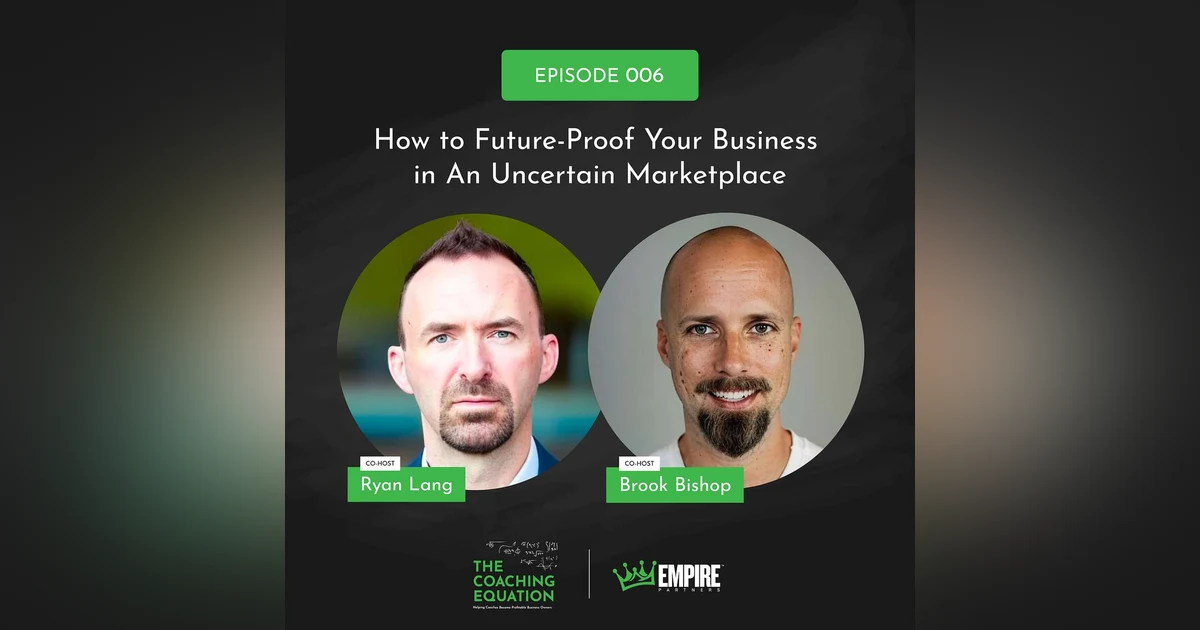
How to Future-Proof Your Business in An Uncertain Marketplace


 RSS Feed
Being the leader of a business in today’s uncertain marketplace is no easy feat, but today on the Coaching Equation, we are sharing some ways you can future-proof your business even in these strange circumstances. Tuning in, you’ll hear about how the marketplace and consumer behavior is changing, the dangerous cancel culture and lack of trust consumers have today, how leaders have to show up differently in marketing, how to develop influence in your business, and so much more! We delve into why leading from a place of fear is problematic before discussing the importance of congruency. We even discuss the importance of speaking your truth regardless of fear and three things you can do to make sure your status as a trusted advisor is elevated. Finally, we give you actionable steps to execute these three elements. You don’t want to miss out on this one so be sure to press play now!
Key Points From This Episode:
- How the marketplace and consumer behavior has changed and is constantly changing.
- Why people are no longer trusting and what that means for business owners.
- How leaders have to show up differently in business and in marketing.
- Some tangible ways someone can develop influence in their business.
- The importance of mission-based leadership instead of leading from fear.
- Why Brook believes that congruency is the new currency.
- The beauty in being able to be yourself as a business leader today.
- Why you cannot be overly afraid of offending people.
- Three critical boxes to tick when trying to elevate your capacity as a trusted advisor.
- How to determine that you are a master at your craft in congruence with serving clients.
- Trust being built from self-belief and what that means for trusted advisors.
- How to cultivate a belief in people that you truly care about them as a business leader.
- The importance of having a desire to be part of someone’s world as a trusted advisor.
Links Mentioned in Today’s Episode:
0:01 Welcome to The Coaching Equation, brought to you by Empire Partners and hosted by Ryan Lang and Brooke Bishop. Our mission is to help you build a profitable and impactful coaching business by cutting through the noise and all the expert advice to deliver tried and true actionable insights that you can deploy in your business today. Each week, we bring on expert guests, unveil cutting-edge tactics and strategies, and share the secrets and stories that we've gathered from working with the most successful coaching companies on earth. Welcome to episode six of the Coaching Equation podcast.
0:43 I'm your host, Ryan Lang, CEO and co-founder of Empire Partners, alongside my co-host and co-founder, Brooke Bishop. And in today's episode, we are diving deep into the critical shift that's happening in today's business landscape. Listen, things have changed and they are changing literally every day. The way that consumers are showing up and buying things and their behavior is changing. The way that we do business is changing. The way that we communicate with people is changing. And as a result, we've got to be willing to make the changes that... that we need to make in our businesses in order to keep up.
1:23 So in this episode, we're going to dive into why authenticity and congruency is more important than it has ever been. Why it's important for us to be able to show up as a trusted advisor. as opposed to an authoritarian. We're going to break down all of the reasons that things have changed, how you can navigate those changes, and exactly what to do in order to win for the long term. This is episode six of the Coaching Equation podcast. Let's dive in. Welcome back to the Coaching Equation Podcast. I'm your host, Ryan Lang, alongside my co-founder and co-host, Brooke Bishop.
2:05 Dude, how are you today? Good, good, good. Rockin'. Good to see you, brother. Yeah, let's rock and roll. So, things have changed. And on today's episode, we're going to really dig into... how the world, how buyers, how clients, how we have changed as a society and how that's impacting our businesses, how we need to show up in our business, in our coaching, in our sales, in our marketing, things have changed. And the reality is that if you're still trying to do things that were working a year ago, two years ago, five years ago, 10 years ago, in some cases, 40, 50 years ago, 40, 50 years You're in big trouble.
2:45 And we want to really dig into how we can thrive, not just survive right now by being aware of how things have changed and how we need to show up differently. So let's kick this thing off, man. I want to kind of start by just going through like, what are some of the ways that you're seeing? And let's kind of start here. The marketplace, consumer behavior, how are things changing? How have they changed? Yeah. Yeah, that's a really, really big question. Really good question. One of our fundamental principles, you and I talk about this all the time, but one of the most critical things we have to do, not just as coaches, not just as business owners, not just as salespeople, but as human beings, we have to be able to understand and appreciate other people's worlds.
3:33 But so many times we walk around as if we know what the hell is going on in everyone else's worlds. And there's an ego, there's an arrogance of like, I'm the King Tut superior. I know what's happening in your world more than you do. The reality is it's constantly evolving. And we have to be able to take a step back and reevaluate what's happening. I don't know if you ever... Have you watched the show alone? No, I haven't seen that one. Crazy show. So they take, I don't know, I think it's 10 people or 12 people and they drop them in this remote area and they're allowed to bring 10 items with them. And whoever out survives the other people, whoever doesn't tap out, they win. But the thing that's always fascinating, so in these survival type situations, the first thing they do is they evaluate their environment.
4:17 They want to figure out where they're at. They want to figure out where's the sun at so they can figure out what their positioning within the earth. They want to figure out where water is. They figure out their shelter. They figure out fire. So they immediately have to take inventory of where they are. In business, we rarely do that. We're just doing our business thing. And so what we've got to take inventory of is like, what's going on in the world right now? Like, is the sun still setting in the West, right? Like, have the magnetic North, has it shifted? Which it has, but that's a different conversation. So within this space of like, what's taking place in the world economy, what's happened in our buyers worlds. So we've got a situation right now where inflation is Richter, right?
4:58 So cost of things has massively gone up. the value of a lot of things has actually gone down, right? We're also in an environment right now where we've got election year uncertainty. We have a lot of people who are like, I don't know what's going to happen. Where's it going to go? The funny thing of that... No one ever knew before. We don't even know what happened the last time it happened anyways. But you've got this new introduction of artificial intelligence. So what does that create? Well, that creates a lot of uncertainty for a lot of people. That also creates a new environment of... I'll say it this way. What I'm seeing that's taking place, and this is across every single industry, every platform...
5:39 you are guilty until proven innocent. And so we've got this cancel culture dynamic. We have this, is it real? Is it true? I don't trust it. What that creates, it fosters this world of massive amounts of uncertainty. People just don't trust anymore. That's where we're getting to is we don't trust our neighbors. We're not trusting people at their store. We're not trusting anything that we see online. We're not trusting ads. We're not trusting technology. We're not trusting the government. We're not trusting Yeah, I agree with you 100%. And I think what's interesting about, I mean, just speaking on the lack of trust issue, not only do we have a lack of trust, but at the same time that we have a lack of trust, we have, I think, and this is obviously it's a direct correlation.
6:26 But in conjunction with the lack of trust, we've got this. incredible rise in interest to find evidence that something is true or right or good or, you know, that results are actually factual type results. You know, it's fascinating because at the same time that people are not trusting, they're looking feverishly for someone and something that they can trust. And that manifests in so many different forms right now. I mean, you know, when we look at this and you've kind of got a great way of explaining this, all the kind of different things and ways that, you know, consumers are behaving now, you know, directly because of that.
7:09 But it used to be that. As a consumer, we would show up at wherever we're going to get whatever it is that we're looking for. We'd show up to the car dealership and we would look to the salesperson to be the expert on the car. Tell me more about the car. Tell me what I need to know to make an informed buying decision right now. And that's changed completely at this point. Now that we've got so much information, you know, most consumers are showing up knowing way more than they used to. That's for sure. And in a lot of cases, whether they're right or they're wrong, by the way, they're showing up in a space where they believe they know better.
7:51 They believe that they have the information necessary to make an informed buying decision. They believe they know what their problem is, etc., etc. And so it's a completely different role that we have to play. And... Maybe you can talk on this because I saw you do it visually recently. And I love this. The way that... How consumers are coming in and looking at all these different things, all these different behaviors that they're doing before they're deciding that they're ready to actually jump. Yes. If we go back... Let's say we go back 10 years ago, just to create a little contrast of the world. 10 years ago, the mass majority of advertising was happening in... Let's just say 3 different locations.
8:32 Okay. commercials on TV. We'd see advertising that was kind of at the zenith of when things were popping on Facebook. Right? And then back then, 10 years ago, we had radio commercials. That was pretty much it or billboards. That was about the extent of where marketing happened and we had direct response. So in those moments in time, people would usually see an ad or they'd see a commercial, they do a little bit of research and then they take action on something, right? Fast forward to today. Now, someone sees an ad, they go, it perks my interest, but I don't know if it's true. So then they go check our personal Facebook page. They then check our business page.
9:12 They then go check to see LinkedIn. Do we have any negative comments? Or how long is the information we have on LinkedIn? Is it matching up with what we have over on our business page over on Facebook? They then want to go see how many Instagram followers we have. They're making decisions on how many people are following us to see... Are we legit? Are we good enough? Do we have enough followers based on this erroneous number they might have in their head? They then want to go check out Trustpilot to see if there's any negative reviews there. They're then going to Google your name. They want to see if you've got an offender. Does your name pop up on some form of an offender's list? They then want to talk to 14 of your previous clients. They then go to your website. They then research and read every single thing on your website. They then want to talk to 4 people in the company to see if everyone's giving the same song and dance.
9:53 And then they still have to think about it. So it's indicative of people wanting to see if there's cracks in the foundation. And what they're really telling us is they need so much freaking certainty. They want to know because so many of these people have been screwed over or they did something in the past. They have a negative association. They've hardwired in their head that when they did this thing, it led to some form of pain or they didn't get the thing that they were promised. And so now we're in an environment where we have to offset that. So that's a really fancy way of saying we have to infuse so much certainty into our prospects, more so than ever in the history of business.
10:38 And what people are really screaming for, they need not just do they want, they need a leader. That's what they're screaming for. I love that. And I think it's a completely different posture to be a leader. And as we would coin it right now, you've got to show up as the trusted advisor, right? You know, leader, trusted advisor is a totally different posture than information expert. Right. Right. And the other thing is that as a trusted advisor and a leader, what you can get away with today is different than it used to be in the past. So one of the things that you and I talk about often, we talked about it on a recent episode, which was, you know, in the sales process, understanding what it's like to do something to somebody as opposed to with somebody.
11:26 Well, this is exactly what we're talking about here in the context of business in general, where in the past, you know, if you were just the information expert and the consumer comes on, you know, you're the car salesman, consumer comes on the car lot. Because you were the one that held all the power. You were the one that knew all the things that was going to tell them how to make a decision. Right. They were coming to you in an inferior posture and you in a very superior posture. And it allowed people and businesses to get away with a lot of things that we can't get away with today. Right. It's a totally different landscape from that standpoint.
12:07 I mean, look at why... I was talking about this on one of our Academy sessions, one of our Mastermind sessions semi-recently regarding why CarMax has had such a meteoric rise. They made such a shift. It was totally against the way that the car business had done things. They said the price is the price. We're just not going to play that game. And guess what? Their salespeople... are not the information experts. They're just trusted advisors. It's just come on in. Let me show you around the lot or better yet, you go walk around, tell me what car you want to drive. Tell me how I can help you. Tell me how I can help you get your financing.
12:49 So it really is a completely different dynamic. When we think about this, so obviously, this is something we talked about this in the context of sales and we can talk more about that. But This is something that truly permeates every single part of our business. And I also think that it now also requires us as leaders inside of our businesses to show up as a different leader than we used to be as well. Because we're also living in a day and age where, you know, like a sports reference, go, you know, back 50, 60 years and you got guys like Newt Rockne and, you know, Vince Lombardi, you know, who could be total hard ass and get away with it.
13:32 We don't live in that culture anymore. You can still have some of that. But this truly, you know, a leader has to show up differently as well. And so... What are your thoughts on how we have to show up in our business differently now? And also, and that's not just leading team members, but how do we also have to show up when we're doing our marketing? How does that have to change? How does it shift our sales approach? How does this affect what we do in business? Really powerful, powerful piece. So when we look at the different styles or types of leadership, and there's... We could do 14 episodes on this. But there's different styles of leadership.
14:12 The one that most of us are familiar with is usually what's called a title leader, right? I hold the title. Therefore, you do what I say. And this comes from a lot of military. This comes from a lot of government. We look at police force. So that's a lot of authoritarian type leadership. Yeah. There's a lot of people that are stuck in that way of thinking of because I hold this title, I've got these letters after my name, therefore you're inferior. It creates a degree of separation in our capacity to influence. And so right before we jumped on for this episode, I was on with one of our clients. It was really fascinating because she's having some hiccups with her team. So she has got... I think she said she has like 7 or 8 people on her team.
14:53 Now, the way that she's running her team is she's running her team from the perspective of this is how I lead. Okay. These are very dangerous words, by the way, anyone hearing this. If you catch yourself in a mode of this is how I lead, that's kind of like being in a relationship and going, this is how I am. If you don't like it, there's the door. Because true leadership, like if you think of it, I know we've thrown the words of like servant leadership around to some extent. I think it's gotten diluted over the course of time. But you to truly be a really good leader is, You have to be multilingual. And I don't just mean like speaking Spanish or German or Japanese, but you need to be able to speak the language of the people you're leading.
15:36 And that means you need to be able to pivot to figure out what is their language? How do they receive information? What drives them? What are their values? What motivates them and moves them? What causes them not to move? So you have to be a master wizard. You've got to be able to understand each person's unique dynamics and lead from that vantage point. not from a place of superiority where it's like, get behind me, you're going to do it my way. It's got to be what's going to drive you and you've got to be able to influence versus the traditional sense of leadership, if that makes sense. It definitely makes sense. And I agree with you 100%. Without going too far down a rabbit hole here, what is one tangible way that somebody can...
16:21 develop influence in their business. So I'll share a story that tees this thing up interestingly. So when I worked for Buffini and company, so anyone doesn't know Brian Buffini is big in the real estate space. At the point in time when I worked with him, we had, I want to say 300 plus coaches on staff. Huge company. The thing that I found that was so rad about how the company ran... And by the way, they've won number one company to work for in Southern California for the last... I don't know, 10 or 15 years or something crazy. But there's this one thing that they had within the company structure that I thought was just so powerful. They have a personality assessment that Brian Buffini's brother created called Heritage Profile.
17:04 Every single employee has their profile and a plaque outside of either their cubicle space or their office space. So if you go into somebody's zone, the first thing you see is their personality profile. Oh, wow. And it tells you what their rhythm is. It tells you how they receive information, how they communicate information, what their values are. You can very quickly, before any engagement, you can go, oh, who am I talking to? Oh, this is how they communicate. Gotcha. And then you can engage. Now, so for somebody who maybe perhaps doesn't have that, this is one of the reasons, by the way, for all of our members in our community, why we have DISC. as a tool, not only internally for our membership, but that's also why anyone who's a member of our world gets access to their own links.
17:48 They can use it with their clients or their staff or their team. So they have a tool to understand what their prospect or what their team members or their spouse or their kids, to be able to know what their model of the world is and how they communicate is such a powerful, it's like a decoder ring. I mean, imagine this. Every prospect you went and spoke with, if you could know in advance how they communicate, how they receive communication, what their rhythm is, what totally turns them off, what turns them on. Dude, it's like the Contra cheat code. A, B, A, B, up, down, up, down, left, right, left, right. B, A, B, A, select start. Yes. It really is.
18:28 I think that in order for us to elevate our game as coaches, we got to become master psychologists. And I don't mean like a master in psychology. We need to become master communicators. We need to become masters of understanding our clients' world. And that doesn't mean that we buy into their circumstances. I want to make sure I distinguish between the two. Yeah. Key distinction. We don't need to buy off on their circumstances. Their circumstances are the result of whatever their stinking thinking has been. But we need to become masters of communication and being able to understand where they're sitting, not take ownership of it. There's another important piece. Anytime we hear coaches go, I'm burning out. Yeah, because you're taking ownership of your client's shit.
19:10 Stop it. But you need to be able to communicate to them from a place of empathy. And you've got to lead them out of the dark. I love that. One of the things that I want to mention, and this kind of goes along with this concept of leading people out of the dark. You know, I've studied this a lot. I've studied leadership my entire life. And one of the things that is really clear when you look at the research is that, and this, by the way, this doesn't just apply to a team. So I want to bring it around to like client facing stuff as well. But A lot of people listening to this right now are learning how to build teams. They're in a spot, perhaps for the first time in their lives, where they have a business and they have one or two people working for them.
19:54 Maybe you're up to 10 by now. Maybe you just have a couple of VAs. Maybe you'd like to be able to hire a couple and you're not really sure how to do it. One of the things that plays right along with what we're talking about right now in terms of being that trusted advisor, both front facing, but also internally, is understanding how to motivate, you know, how to lead with motivation and motivating based tactics as opposed to fear based tactics. Because here's the thing. You know, one of the reasons I'm so passionate about leadership, and I can't even tell you why this is, but since the time that I was a little kid, I paid really close attention to the people that led me, the ones that I allowed to lead me.
20:39 And then in situations where, you know, maybe I had a JLB or something like that, and I didn't have a choice about who was leading me, but I paid very close attention to how they acted, what they did. be able to really rally the troops and the people that would bark orders. And, you know, and I'd watch employees begrudgingly go about doing the tasks that they, you know, go and do. And then everybody, you know, would be around the water cooler having a bitch session at, you know, six o'clock every day. And one of the things that's really, really clear when you look at the research is that motivating people through...
21:23 mission and purpose and positive outcomes is way more effective than motivating them through fear or by fear. And where this is really important is number one, internally, if you do have a couple of people that are working for you, or if you'd like to hire a couple of people, or if you've already got a team, just to your point, just telling people how it is and saying, just go do just because I'm the boss and that's just how it works. That's not going to take you very far. You're going to have massive turnover. People will quit on you when it's hard. They won't do the things they're going to need to do. And the truth is, in today's day and age, you have to be able to over deliver.
22:03 And in order to have employees or even virtual assistants that are willing to bend over backwards for you, for your clients, they've got to be motivated by something deeper than just because and because I'm the boss and just go do it. They have to be motivated by purpose and mission and substance and, you know, and positive motivators. And the interesting thing about this is that it's not just something that we do internally, but this is now how we have to show up in our businesses as well. Right. And it doesn't mean, by the way, that we completely ignore people's pain points and their fears and all of that stuff. But here's another thing. And I'm going to go out on a ledge here.
22:44 But the days of just being able to market with fear tactics are dead. They're gone. And sadly, this is the way that a lot of people have been taught to market. And it's so sad because right now, if that's the way you're marketing, you're screwed right now. So yeah, I think this is really, really huge. Now you're spot on. I mean, even the social media platforms, they drop your ads if you're using pain tactics. So there's tons of research that's been done. If you're using massive amounts of pain to try and move people through your ads, they don't even put your stuff in front of people anymore.
23:26 So you have to be really clever in how you can hit on pain points and how you can speak to it. But you're absolutely right. When it comes to leadership, If you're leading from an authoritarian position, I hate to say it, we look at the real estate world, you have buyers markets and sellers markets. Right now in the world of business, if you have a team and you're trying to play the authoritarian role, I hate to say it, but you don't have the cards. It's not stacked in your favor, right? The leverage is in the hands of the employees now because they know they can flip you the bird and they're gonna just walk down the street because everybody's trying to find good talent. They're trying to find good quality help. And it's few and far between. So that means we have to up-level our game in leadership.
24:08 We have to up-level being the trusted advisor. And it comes back to the original core piece we were talking about. The environment's changed. The psychology has changed. Now, more than anything, authenticity, congruency... I'm going to say that word one more time. Yeah. Congruency is the present day currency. If you're incongruent, people will not want to work with you. They're not going to want to stay in your world. If you are congruent, people will follow you into battle. And that's paramount. And you mentioned the word a moment ago being mission driven. How many people have we met that are like, I have a mission statement. It's like, cool. When was the last time you read it? Yeah. You and I know a company that had, I want to say it was what, 22 values, core values in the company.
24:52 And it's like, the leader of the company couldn't even, didn't even know what they were. It was just like reading through a slide deck. So there's this dynamic of, are you doing the action or are you living the, the actions. And that's where the world's at right now. Now people want to know, are we congruent with our message? Is our physiology? Does our facial expression match the words? I was about to say a metaphor that would just be totally inappropriate. But there's this dynamic of, are we really who we say we are? Are we showing up as the real deal? Because if it's just straight authority, actually, oh, there's something you triggered on that. And I don't know if you've caught this before, because I know we've both worked with numerous companies over the course of time.
25:34 One thing that I've seen true is that the way people raise their kids is exactly how they also show up as a leader in their companies. Hmm. Wow. So the company that'll go unnamed, but his kids were out of freaking control. And he had different rules for each of the kids. And he also showed up to his team, his sales team, different rules for all the different people on the team. And it created the same exact environment. And it was very fascinating because I saw somebody else in the company who had a different team. And she didn't ever communicate what the rules were to her own kids. So they were just trying to figure out what they were. And her team was chaos for a totally different reason. So it's very fascinating when we look at how we parent and also how we...
26:17 raise our teams. I mean, it goes back to the old saying that how you do anything is how you do everything, right? Yep. I love that you brought that up, dude. I mean, first of all, I'll be honest with you. I've never heard anybody say that. And I think it's a brilliant point. And I think you're spot on. I think that the thought that we're going to compartmentalize so well is, that we have the capacity to show up that differently in each role, I think is faulty logic. And anybody who's a human and has been in leadership has probably tried to do that. Do what I say, not what I do. Or, you know, I show up one way over here and a different way over there.
26:59 But, you know, one of the things that I love about this is that this also, we talk about being a trusted advisor and being authentic and congruent. These are really important words because they also go down to the foundation of you, the human. And one of the things that I think is really refreshing, to be honest, as much as things have changed and we have to learn how to navigate this new environment, on some level, it's actually simpler than it used to be. Because... In the old days, when there wasn't social media following us around 24 hours a day, and there wasn't the internet, and there weren't all these social proof and tons of peer reviews and even companies that did that kind of stuff, you could easily have a company where you or your company put one thing that was front-facing, and then behind the scenes, you were totally different.
28:00 Right. And having been somebody, which, by the way, I mean, I'm not afraid. I've told my story many times and will continue to do so. I did that to a large degree when I was a total shit show many years ago when I was making money hand over fist and, you know, showing up one way and not wanting anybody to see what my personal life really looked like, which was a mess. And I hated myself as a human. Right. I was right on the fringe of being able to get away with that at that point from a timeline perspective. But the truth is today, it's way harder to do that. And one of the things that's great about that is that for those of us that would love to just be able to show up like ourselves, congratulations.
28:45 Like... You know, you can do that now as long as, you know, who you portray yourself to be is actually who you are. And if that's the case, it's actually not that hard. In fact, not only is it not that hard, it's now something where it used to be, I mean, think back, you know, if we think about some of the... You know, if we think about the entertainment industry as an example, and we think back on actors and actresses and musicians and politicians, that factor that falls into the entertainment category, doesn't it? It does. When we think about those, you know. Think about how many stories we hear of like advisors going, you can't say this, you know, you can't be that way.
29:33 I remember Gary Vee, you know, telling a story about, you know, kind of like his early ongoings, you know, after Wine Library when he was kind of out there doing the things. And he's like, man, you know, my people are telling me like my publicist is like, Gary, you can't go say fuck on stage. And he's like, I can't not say fuck on stage because it's just who I am. Right. And the beauty is that we get to be that today. And one of the things that I love about that is whoever you are and however you show up, you're going to attract the tribe of people that are divinely meant for you and your message and the way that you show up. And that to me is actually really powerful.
30:15 refreshing. It is a change and it's something we all have to get used to. But it's refreshing because now we can just go be who we are. And you know... I want to double click on that because I think this is really important. Because there's... I agree with you 1 million percent, by the way. And I'm also stoked at the fact that we can be who we are and we can roll with it. But I can't tell you how many people are petrified of repelling anyone. Right? Oh, talk about that. So true. This morning, I was talking to a perspective, somebody that was looking at joining our mastermind. And her whole thing is she goes, I haven't said anything on social media because I don't want to hurt anyone's feelings. What do you mean you don't want to hurt anyone's feelings?
30:55 And so she's so petrified of speaking her truth. She doesn't want to offend anyone. So she's sitting silent. And as soon as I said, well, wait a minute. You've got people that are out there that are dying on the vine, literally. So her offer for people who have type 2 diabetes. I'm like, so you're afraid of saying anything that might offend somebody. Yet you have people who are literally dying by the thousands, if not more, every single day. And so I agree with you 100%. We have to speak our truth and we have to get loud and we have to be who we are and we got to go full tilt. I just want to throw this out to anyone who's sitting there that's been quiet, that's been the secret agent coach. Get out of your fear bubble because your fear bubble is your own fear of being judged or having somebody who unfriends you.
31:39 Or like there's power in repelling the people who are not part of your world. There's just this dynamic of be who you are, but don't be afraid of losing the wrong people. Emphasis, your wrong people. Like, get them out of there. Yeah. This is a great point. And I think this ties so perfectly to, again, I want to tie it back to that concept of trusted advisor. All right. Think about the people that you know in your life that you look up to as an advisor, as a mentor, as a guide. Right? Right. Not one of them, I would be willing to bet that there's not a single one that you can name that doesn't stand for something.
32:23 That you don't know, you know, what they stand for, what their mission is, what they're passionate about, right? That's one of the reasons that we follow those people. is that they inspire us to become better, to seek and search out that next version of ourselves, to do things that are uncomfortable, right? And that's what it takes. So if we're truly gonna show up as the trusted advisor, we can't be that. There is no, you know, the trusted advisor has got clear vision around where he or she is going, you know, what the right solutions are, how to find the right solutions, their viewpoint on the thing that they teach on or they coach on or that their business does.
33:07 And they're not afraid to say so. And I think this is one of the things I agree with you so, so much. And let's think about even a slightly different way. Like what Brooke is saying is so true, which is, Hey, You don't need to be in the shadows anymore. But even if we take... Let's think about this. Let's take the whole idea of, you know, like the consigliere, right? You know, the trusted advisor who's truly like behind the scenes of, you know, the powerful person, right? One of the things that those people do so effectively, even when they're not seen or heard by the public, is they don't pull any punches. There is no bullshit with those people.
33:49 That's what they get paid for, right? And I think, you know, the only difference in this case here is that we're talking as a business. You can't be the trusted advisor and be completely in the shadows because then nobody knows you. They don't know what you stand for. They don't know what you do. They don't know, you know, know how you help, who you help, why you're any different. And that's why it's important to do it, you know, publicly. But even those that are in the shadows are, you know, very clear and don't pull any punches. And I think that's a great point, dude. That's it. It's so true. And in the space of the trusted advisory, even the words, I think people have become used to hearing trusted advisor. And it's almost... Again, language in our world has become somewhat diluted in these last few years.
34:34 But there's 3 questions that I've seen that become so critical if you're trying to elevate your capacities in this area. So the first is, are you a master of your craft? Yeah. Like, are you really actually good at what you do? Number two is, can I actually trust you? And how does that come up? Is it because you're telling me to trust you? Or can I actually trust you? Do you have your own driving force on this thing? Are you really in it to your point? Which I think was so brilliant. Are you living out a mission that's congruent with what you believe? Or are you just doing something to take my money? And then the third one, and this is the part that's critical, is do you genuinely care about me?
35:15 And my needs, right? If you check those boxes, people are going to come to you. They're going to refer their friends and family to you. They're going to want to stay in your orbit because for the mass majority of people, they don't have very many of those people that are in their inner cabinet that they can lean on in that way. Right? Like people are screaming for that. I totally agree. And you know what, all this talk also reminds me of, you know, one of my favorite quotes from one of my favorite people on the face of the planet, Simon Sinek, which is people don't buy what you do, they buy why you do it. And my goodness, what's so interesting about that is that Simon Sinek originally did that talk, I think it was like 2010.
35:58 And it was 2000, I think it was around 2010, 2011, which is wild. And by the way, if you don't know what I'm talking about right now, get your freaking fingers typing in YouTube right now and go watch Simon Sinek's talk on the power of why. But what's so interesting about it is that he did that talk all the way back then. The concept happened then. It mattered then. It matters a hundred times more now than it did in 2010 or 2011. I mean, it's not even close. So... That's crazy. Yeah, it is. It's wild to think that it was that long ago that he did that. But... You know, so I love these steps, man.
36:40 So are you a master of your craft? Can I trust you? And do you care about me? Let's take the last couple of minutes that we've got today and kind of break that down because I want to leave people with something actionable that they can go do to truly start becoming the trusted advisor in their space, in their business, in their relationships. Yeah. So master of craft, obviously, I mean, I think we all get what master of craft is. But one thing that I'd love to touch on you and I right now is this. Somebody right now who's listening to this is doubting whether or not they are truly a master of their craft.
37:20 And we can and will do a whole episode on imposter syndrome. So I don't want to go too far down that rabbit hole. But really quickly, let's just say for a minute, how do we determine if we are truly a master of our craft at a level that would allow us to be incongruent? Not incongruent. Incongruence. Yeah, incongruence with charging money and serving clients. Yeah. So there's two pieces to this coin and I want to highlight this. The first part is you have to adopt a psychology around the training never stops.
38:02 Yes. Preach. The training never stops because you're either growing or you're dying. Right now, in terms of mastering your craft, if you're on the pursuit of mastery, that's like check one. Number two is, are you in a position to be able to help yourself one to two years ago? Great distinction. Wow. Say that one more time because I want the person listening to this to really get really hone in on this. Are you in a position right now that you of one to two years ago was having a conversation with yourself right here today? Could you help that version of you? If the answer is yes, there's a certain amount of mastery that you've acquired that you now have the ability to help somebody else that was in the same shoes you were in.
38:45 Okay. So that kind of checks the box for mastery. But again, you have to have that consistent drive to always be improving and to level up your skill set. Because guess what? Two years from now, the same question is going to come up. Can you help the person that you are today? Like you've got to consistently be going down the road so you can be elevating your skill set. I love this. The master is the constant student, right? And this is one of those deals, you know, I've said this many times in just about every area of my life. The day that I wake up and I go, ooh, I got this. I'm screwed. That's so true. So I believe truly like you that in the pursuit of mastery, we do not ever arrive.
39:26 And that allows the journey to truly be the juice instead of, you know, some kind of, you know, arrival point or outcome. So one other thing that I do want to mention on that front is this. You may legitimately be in a spot right now where you're listening to this and you're going, you know what, like if I'm being really honest, you know, I'm going to be I don't know that I could help me one or two years ago. That might be a thing. Like, let's just call a spade a spade. Because one thing that I think is rampant right now that I don't want us to be the purveyors of is the idea that, you know, anybody can be an expert. That is such bullshit.
40:06 I'm so tired of it. And I feel like, I mean, there are a whole lot of people charging a whole lot of money that'll take your money when you're not truly ready to be an expert. And so you might be in a spot right now where you're legitimately putting yourself against that litmus test and going, you know what? I don't know that I could help myself. So then if that's where you are, you know what the mission is. If that's who you want to be, you're on a mission now to become the person who could help the person you were a year or two ago. Go cultivate your skill set. Go find the mentors that you need to get you where you need to go. That kind of thing. So let's move on to number two. Let's talk about trust. How do we cultivate a sense of trust in our customers and in our team members?
40:50 You hit on it pretty heavy, which is speaking your truth. And this is where trust is established through truth. Yeah. truth is also subjective. So why this is so important, you have to speak your version of the truth and you need to communicate it in a way that is authentically you. If somebody goes, Oh, how are you doing today? And you just go, I'm good. but you're really feeling bad, they're not going to trust you. They're going to think that you're lying to them because you are. So the truth is also there when it comes to telling your clients or your prospects the truth about their situation. And what we see so many times, especially in a sales conversation, is a coach in a sales engagement, they're more concerned with being liked by their prospect than...
41:37 than they are about speaking the truth and having a real honest dialogue with them. And they dilute. They dilute the impact. They dilute the scenario or the situation that they're in. They dilute the reality of what they need to do. They dilute the pain that's right around the corner because they don't want to hurt their feelings or they don't want to lose their connection. So trust is really established through speaking your truth in a loving way, but it's having that real honest conversation. I love that. One of the things that I want to bring up as well, I agree with everything that you just said, and I want to pull in kind of an outlier into the conversation about trust. I also believe that trust is cultivated through trust.
42:21 Self-confidence and self-confidence. I'm stealing this. I have no idea if this was the original person who said it, but I certainly have heard Ed Milet say this, which is that self-confidence is keeping the promises that you make to yourself. Mm hmm. right? We basically build that up, right? And one of the things that I think is shining through today more than it has ever before is that our ability to be someone different for other people than we are for ourselves, that's getting harder and harder and harder. And the truth is that if you can't fully trust yourself, right?
43:07 There are people who will pick up on that and they will pick up on the fact that you're not as confident as you could be otherwise. When you're in your meetings, when you're having sales conversations, when you're creating videos or doing marketing or talking about what you do. And I think that it starts with that self-confidence and, you know, kind of the savings account that we build up with ourselves when we drop that penny or that quarter in the piggy bank after we've kept a promise that we keep to ourselves. Love that. Yeah. Just to summarize a piece of that, because I think this is a way of compressing that. Trust happens when you're clear on what your values are, what you believe in.
43:48 And then you're in alignment with how you're upholding them. Right. So we've got clarity in your values and then you actually embody it like the fruits on the tree. Yep. Love it. Okay. So now we're talking about this third and final piece that you brought to the table here, which is... How do I know that you care about me? How do we cultivate that sense of, you know, belief in people that we truly care about them, about their needs, etc? I'm gonna say it's semi-loaded. So what I'm about to say is more of the action and the way that it shows up. And I know that there's a lot of people that are going to go, oh, well, they said to do this action, but they're going to miss out on a key piece, which is the heart component of it.
44:34 So one of the things, as an example, something that I do to show people that I care as I reach out to them. I'll just send them text messages. Hey, I was thinking about you. Want to see how you're doing? How's your spouse doing? How's your dog doing? How's your dog? Did Billy kick ass on his baseball game on Sunday? But taking a genuine interest in their world that's beyond what you're offering or your services, because if you can see past that, you're going to see them as a human being or as a soul being that's here, that's having an experience that you're engaging with. And then your product or service is a piece of the equation. It's not the end-all, be-all. It's not the destination, if that makes sense. And so a huge piece of that, honestly, and this is just a practice that I have.
45:15 I don't even know if I've shared this with you. So all of our clients I have on a lucid chart. So I have pictures of all of our... This is not surprising to me. This man lives in lucid charts. Here's what I do with this is every day I give thanks for the people who we get to work with. And so a huge part of genuinely caring about them as first is just being grateful for them being in our experience of it because they're enhancing our experience. Not only are they paying us to help them, but I'm genuinely grateful for who they are. I'm grateful. And when I give thanks for them, I also give thanks for the work that they do. Because I know that they're out there having an effect. They're impacting other people.
45:56 And we get to be a piece of that equation. So a huge part of that genuinely caring is honestly, it comes from a space of gratitude. And that knowing that we're in their experience for a divine reason that's beyond my understanding. That is beautiful, dude. I didn't know that you did that. So I love that. You know, I thought you were a really deplorable human being until like 30 seconds ago. And now I'm just creepy. Yeah, now that's exactly right. Yeah. Now I'm like, I have visions of you like, you know, pouring over your lucid chart like Steve Buscemi and... Everyone has clothes on. I want to just, I want to preface... Oh, man. We do have really good looking people in our orbit.
46:38 However, that's not... Yes, we do. Thank God we fired HR. Oh, seriously. Anyway. You know, I want to mention as well that as we're talking about, I want to tie this back to the top of the conversation or not top of the conversation, but earlier when we talked about leadership. Because... This idea about people wanting to know that you care about them doesn't just extend to your customers and your clients. It extends to your team and the people that are working for you. And here's the deal. Once again, circling back to mission and purpose and all those kinds of things... I have seen, and I'm sure you have too, Brooke, many a leader who takes no time to ask about their employees or the people that are working for them or their contractors.
47:29 How are they? How are their families? To remember what was going on in their lives. Oh, I remember the last time we chatted, you told me about XYZ. How's that going? What's going on with that? Yeah. It matters, guys. And here's one of the foundational pieces of getting people to understand that you truly do care about them is just asking more questions. Ask more questions. And listen. Yeah. And actually be interested in the answer that they give. Right. That's the thing, because it's asking the question without being interested in the answer is totally useless.
48:09 And sadly, there are a lot of people that do that. Oh, ask more questions. Oh, OK. You know, except they don't really give a shit about the answer. Ask and be truly interested in the answer and spend more time doing that as opposed to talking about yourself and how awesome you are. And people will love you for it as they should because you're showing genuine interest and care. And by the way, you're going to end up getting that back as well. And if you want a team that's willing to run through the wall for you. Pay more attention to people's lives, care about them, spend time with them, take the time to call them or text them or see how they're doing outside of just work stuff. And, you know, and you'll create a culture and an environment that is second to none in your industry.
48:52 So... This was so good today. And I feel like we went several places that we didn't even mean to go necessarily. And some of the best episodes happen that way. So, brother, thanks for everything that you brought to this. Because I think that right now, we really are in an environment where we have to figure this out. And we have to figure it out quickly. Things are moving and shifting and changing. And a lot of people are scrambling to catch up. So, hope that you got a lot out of this episode. Brooke, anything that you want to add before we tie this one up? Yeah. One piece of recap. I'm only bringing it up because you mentioned something I think so powerful. We talked early in the episode about understanding and appreciating other people's worlds.
49:34 Being a true trusted advisor comes from is the desire. to be that. The desire to understand and appreciate someone else's world. That desire that's within us, we all have that capacity. But we have to get out of our own way. And I'm so stoked that we got to talk about this today because I think that this is such a huge piece. There's so many people that for the last forever, they've been trying to do something to someone or they've been trying to get their marketing to do something to someone so that they'll buy whatever they're offering. And I think that bringing this real conversation to the table of like, get back to why you got in this game in the first place and really tap into that desire to help and understand someone's world so you can get them out.
50:14 Now, thank you, man. Thank you for bringing this topic to the table. Thank you for opening this can today for us to explore. Yeah, absolutely, dude. And thank you for all the value that you brought. Hope that you got a lot out of this episode. We've got so much more good stuff to come. More amazing guests, a lot more really, really relevant topics. So stay tuned for the next episode. Thank you for listening to the Coaching Equation podcast. I'm Ryan Lang alongside Brooke Bishop, and we'll see you on the flip side. Thank you for listening to this episode of The Coaching Equation. Please hit subscribe wherever you listen to your podcasts. And if you got value out of this episode, we would be so grateful if you would share it out with a friend and leave us a review on iTunes or your favorite platform.
51:01 To learn more about Empire Partners or to inquire about working with Ryan and Brooke, please visit www.empirepartners.io forward slash go.

