How to Go From Burned Out Coach to Thriving Business Owner


 RSS Feed
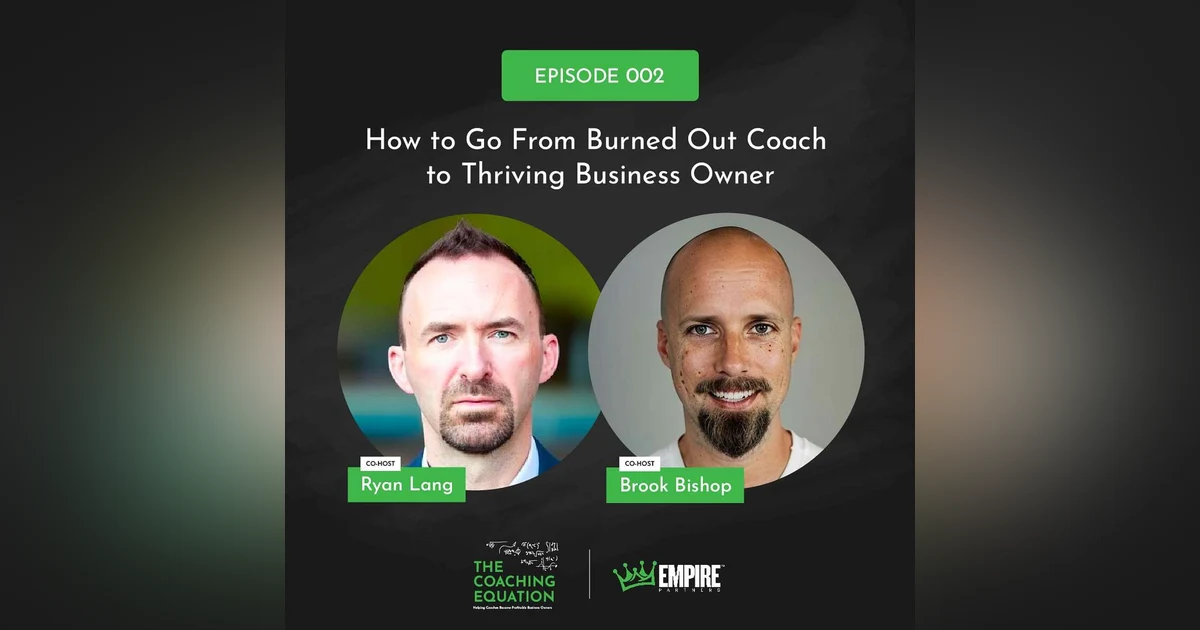
If you’re a coach, it’s highly likely that you are passionate about helping others get in alignment with their dreams, their lives, and their purpose. But if you’re pouring the majority of your time and energy into other people, there’s a surprisingly high chance that you might actually be out of alignment yourself – and even suffering from burnout (or fast approaching it). In today’s episode, we get into the four ‘Ps’ and the ‘C’ of Doom, also known as burnout. We unpack what we can do to avoid the circumstances that lead to burnout, steps for bringing us back into alignment with our purpose, and how we can learn to let go of a mindset of scarcity and step into one of abundance. Tune in to hear Ryan Lang and Brook Bishop’s insights on the causes of burnout, how to address them, and why it’s so difficult to recognize burnout when you’re in it (especially if you’re a high achiever). Join us for this important conversation on burnout, coaching, and getting your groove back!
Key Points From This Episode:
- Taking a closer look at the prevalence of burnout among coaches.
- The concept of the first ‘P’, ‘Progress equals happiness’, and how it relates to burnout.
- Why it’s so important to get clear on the definition of progress for yourself.
- Tips on how to determine where you’re at and what progress looks like for you.
- Being in alignment with the second ‘P’, your ‘Purpose’.
- How being out of alignment can cause burnout.
- Simple steps for connecting to your purpose on a daily basis.
- Contextualizing the role of the third ‘P’, ‘Psychology’ in burnout.
- Shifting your mindset and examining your psychology as a coach.
- How to start showing up as a business owner and entrepreneur, rather than an employee.
- Understanding the fourth ‘P’, the ‘Plan’, and how it relates to burnout.
- Why your plan doesn’t need to be perfect before you take action.
- Advice on figuring out where you might be stuck.
- Insights on how you can learn to plan differently.
- The ‘C’ of Doom, ‘Chasing Certainty’, and its relationships to a mindset of scarcity.
- Reflections on why not everyone is meant to be business owners.
- As always, remember to reach out if you have any questions or feedback!
Links Mentioned in Today’s Episode:
0:01 Welcome to The Coaching Equation, brought to you by Empire Partners and hosted by Ryan Lang and Brooke Bishop. Our mission is to help you build a profitable and impactful coaching business by cutting through the noise and all the expert advice to deliver tried and true actionable insights that you can deploy in your business today. Each week, we bring on expert guests, unveil cutting edge tactics and strategies, and share the secrets and stories that we've gathered from working with the most successful coaching companies on earth. All right, welcome back to the Coaching Equation podcast.
0:42 I'm Ryan Lang and Brooke Bishop here with me. Dude, we've got such a good episode today. We're going to dive into the four P's and the C of doom. Burning out as a coach. This is a real thing. And I want you to lend some context to it, dude. By the way, I can't say the word, I don't know. I can't say the word doom without thinking Indiana Jones and like, dude, getting his heart ripped out and like... I don't know. It's a thing for me, bro. How are you doing? Good, man. Doing super, super good. I'm pumped for this topic just because I think it's such a timely topic. Yeah. And I mean, well, just on that note, speaking of timely.
1:22 So it was about two weeks ago, we were on a training with about 400 coaches and we posed the question to him. We said, Hey, who here as a coach is feeling burned out or you're on the verge of burnout? Yeah. And the chat line blew up. Literally, it was just rolling. It was everyone, me, me, me, me, me, me, me, me. It was just scrolling down. And it just really triggered this part of the brain, which was like, wow, the people who are out there helping other people avoid burnout, the people who are out there helping other people get in alignment with their life and go after their dreams and their purpose, they're screaming for air. And so I thought it was really just a powerful representation of where the world is at.
2:04 But also the people who are the most skilled, the people who are the personal trainers of burnout are burning out. So that was going to be a really killer topic for you and I to just crack into and not only provide some solutions to it, but just provide some awareness and understanding around where and why and how that happens. Yeah, I love that. And that's a lot of what this podcast is about is really looking around at what we're seeing and hearing and finding from all of the coaches that we have the benefit of working with on a day in day out basis. And this one in particular, I want to give a word of caution. If right now you kind of heard the word burnout and you're tuning out already, you're going, oh, no, it's not me.
2:46 Hold tight. Hold tight for a minute because oftentimes, like I've been there. Brooke, I'm sure you've been there. A lot of times when we're burnt out or we're really close, we're on the way or we're on the precipice of being burnt out, so often we don't recognize it. Like I think that burnout in general, a lot of times, especially as like driving high achiever type A, you know, personality people. I think it's really easy for us to not recognize some of the signs and believe that the only way that we're actually burning out is when we're like on a heap on the floor, lying in the fetal position, bawling our eyes out or something.
3:29 And nothing could be further from the truth. So with that, let's go ahead and dive in, man. We've got four Ps that we're going to uncover today. So let's start with the first one. Progress equals happiness. I think everybody has some sort of a loose framework around that, but this is a really, really big one. So why don't you kick us off here and kind of get into the granular detail on progress equals happiness? Yeah. So this is a principle that when working with Tony Robbins, this is something that would come out of his mouth every single event. Every single time we did anything, it was like progress equals happiness, right? He'd go into his conversation about it. as it relates or pertains to burnout, the opposite is true.
4:10 So lack of progress or not moving or being stuck equals pain or frustration or burnout, right? So there's this element of, okay, well, what is progress then? Because if progress equals happiness, and that's what we're really all after, when we're happy, we have infinite energy. And so I think there's this 60 years in the US, where it used to be progress, progress, progress, progress, right? Where we're putting people on the moon and there was this progress dynamic that was part of our culture. Fast forward to today, and there's almost like a different dynamic within the cultural setting, which is like misery loves company.
4:53 It's like, oh, you're struggling. I'm struggling too. Oh, you're in financial distress. I'm in financial distress too. Oh, you've gained some extra 10 pounds. I've gained 50. There's this dynamic of culturally that we want to dive into everyone else's toxic soup, which means if we're not focusing on progress, we ain't going to be very happy. I love that. And in your mind, how do we kind of figure out whether we're truly making progress or not? I mean, obviously, there are things that we can do that give us like really, really clear benchmarks. And there's no question that we're moving the needle on something. But a lot of times, especially when we're talking about business, we get hooked to metrics and things like that to tell us whether we're making progress or we're not.
5:36 So I want to really define for the person that's listening to this right now who really needs to start making some progress so they can be happier. How do we figure out what progress looks like? Dude, it's such a good freaking question. The cardinal mistake that happens in the world of business is looking at one scoreboard. And that scoreboard is how much money did I make today? Or how much money did I make this week? How much money did I make this month? And when that becomes the only metric that you look at, it's a very dangerous game. It's a roller coaster. And I don't think a lot of entrepreneurs or coaches, especially for that matter, they don't realize that the effort usually comes like it's behind the roller coaster.
6:17 So if you're looking at your revenue, your emotions are going to sit right behind that roller coaster. So the revenue goes up. You're like, woohoo. Then the next month it goes down and you're like, oh no. And so your activities trail, whatever that roller coaster is, whatever it's looking like. And so I think it's really imperative that as entrepreneurs, as business owners, as coaches, you've got to track and monitor the core components. Like look at the things that you're doing, the things that you're getting victory on, even on a daily basis of like, what did I set out to do today? Did I accomplish it? And sit in the joy of like, hell yeah, I kicked ass on that today. Pat yourself on the back, give yourself a little high five. So progress equaling happiness is not limited to progress and revenue this month equals happiness.
7:00 Love that. I love it. And you're absolutely right. And what I want to highlight for you is that this is not just about making progress, but being really clear about the definition of progress. for you and the circumstances that you're in right now and your business and your personal life, you know, all of those things I think is absolutely key because here's the other part. If we, based on what you're saying, which is accurate, if we don't properly define progress, then essentially we end up telling ourselves bullshit lies is what happens, right? I'm not making progress. I'm not moving. Da, da, da, da, da, da, da.
7:40 And if you find yourself in that situation right now, I would challenge you to do something really important, which is sit down and ask yourself what's actually true about that, right? What is actually true about that? And you might be right. You might be stuck right now. That could be a fact. But before you decide that, make sure that you really run that through the filter and the litmus test of truth and look at the ways that maybe you could be making progress right now that you're just not identifying. I think that's a big piece of the puzzle. I love that. And for people who have been in the rut of being an employee over the course of time, and they're really committed to becoming an entrepreneur.
8:22 If you're not getting progress, perhaps that you desire on the revenue side, so go, great. Okay, where am I making progress in my marketing? Where am I making progress in my sales? Where am I making progress in my operations? Where am I making progress with my clients? Where am I making progress in my accounting? Where am I making progress in my reporting? Look at all the different pieces of the business. Don't just get myopic and go, what's the top line revenue? Oh, crap. I'm not progressing. And then getting into that emotional downward spiral. Yeah. Yep, yep, yep, yep, absolutely. So wrapping up P number one, make sure number one that you are making progress. Make sure number two that you've got a clear definition of progress.
9:02 And 2A in my mind would be don't let yourself get caught in the trap of believing that progress has to be a huge leap. That's another big trap in this game. is that we believe that it's got to be some massive step that we have taken or some big accomplishment. Allow progress to happen on a granular level, one baby step at a time, and you're going to be a whole lot happier. Like you mentioned a few minutes ago, Being able to kind of see those small wins and give yourself that high five and pat on the back at the end of the day, I think is absolutely vital. And I'd say that's one of the reasons, too, that I'm a big proponent of making sure that you capture a couple of wins every day, no matter how small they might be.
9:49 That's going to be a clear indicator of whether you're making progress and you can truly be honest with yourself about that. Love that. Great distinction, man. Okay. P number two is purpose. Now this is, that's a word that carries a lot of weight and gets chucked around a lot. So let's dig into this particular P as it relates to burnout. So purpose, when it comes to this, if you're out of alignment with your purpose, you're immediately going to feel like you're doing something for somebody else. And it can be very quickly just becomes this. It's a bucket with not a whole lot of fuel sitting in it. So when we talk about purpose in regards to the dynamics here, there's a lot of people that are on their mission.
10:29 I want to find my life's purpose. Cool. If you're going to go out and look for that, that's not what we're talking about here. We're talking about more from the perspective of a command and demand aspect. So if you're a coach and you're working with other people, you sure as shit better know what your purpose is and you better know what your mission is and why the heck you want to help them. If you're driving forces, because I want to make money, Okay, well, that can be okay if you have a money offer. If you have a save a marriage offer and your whole driving forces make money, this can create some conflict. So we're talking about purpose. If you don't have daily rituals, if you don't have those dynamics to keep you connected with that. you will go into default mode, which is usually scarcity survival because that's how our brain's hardwired.
11:12 So it can't be all about you. If your purpose and your mission and your vision within your business, if you're not associated to it, you will burn out because it's a game that doesn't have the fuel. That's what purpose really is the fuel. Your business and your coaching capacity is the vehicle. The purpose and why you're doing it is the fuel for the vehicle. I love to get your insights on that one though. Yeah, this is a big one for me because I think that oftentimes in life, when we're trying to get ourselves to do something, the P and purpose behind it is usually not strong enough when we're not moving. And, you know, inside a business, I think this is a really great one because it's easy to get disconnected from your purpose.
11:57 Because let's be real. If you're running a business, there's a lot of shit going on, right? You're doing lead gen. You're trying to get clients in the door. You might be managing a team of people. You're trying to make sure that your revenue is exceeding your expenses. You're worrying about your family. Right. It gets really easy when we I was saying this on one of our group coaching calls recently that when we start out, everybody is aligned with their heart and their purpose. We were having that conversation the other day because the shit hasn't hit the fan yet. Right. We're literally just in that spot where we're building something that comes from the heart. And we want to go out and do our thing and be connected to our purpose and use our gifts and all of that stuff.
12:42 And then you get in the middle of running a business and actually doing it. And there are so many different things swirling around every day that it's easy to get disconnected. And I think that I would urge everybody listening. If you're listening to this right now, check in with yourself on this one. Are you currently connected to your purpose? And that doesn't mean do you know what it is? Because knowing what it is and acting from that place are two totally different things. And really what we're talking about here is on a day in day out basis. Are you connected to it? Meaning that the actions that you're taking are inspired of your purpose. So I, yeah, I was going to give one little tool with that, that I think can help people if they, if they're like, Oh, I don't know fully what my purpose is, or I feel like I'm out of whack with it.
13:30 The easiest way to get back into that mode. There's, there's two ways. Number one is gratitude. Yeah. Right. And then number two is make a list of the clients you've worked with or the impact you're having, or I know you're, you and I are both such huge fans of journaling. But literally, before you start your workday, if you just sit down and go, okay, who am I serving today? And how am I going to help them? And what's the impact it's going to have? Regardless of what the... If you can't put your purpose into this little package, nice, neat container, you're immediately going to be aligned with something that's greater than you. It's not about you. It's about the... Instead of me versus we kind of a concept. Yeah. But it gets you back to that center point where it's like, okay, here's my mission for today. Okay.
14:10 It doesn't have to be your grand life purpose and this incarnation or whatever the heck we want to throw at it. But it's what is my purpose and my mission today? I love that. And I couldn't agree with you more. I think one of the thing with regard to purpose and you talked about, you know, me being in a lot of cases when we're out of whack here, it's me being greater than we and. Here's one thing that I want to mention in this is that oftentimes when you get disconnected from your purpose is also the time, you know, you and I were having a conversation offline before we started today about how fearful people get about making decisions. And this is a big thing inside of business.
14:52 Speed to decision is vital. And if you find yourself in a spot where you're spinning your wheels and you're not making decisions, check in on your purpose. Because here's the thing. When we're disconnected from our purpose and we're talking and we're worrying about ourselves and we're focused on me instead of we, making those decisions gets a whole lot harder. When we got to make a really tough decision, but it's aligned with our purpose and our mission, it's much easier to make and we'll make it faster. Yeah. So stinking smart. Yes. Yes, yes, yes. With an extra side of yes. Supersize the yes, baby. All right.
15:33 So P number three, P number three, three P is psychology. And this one, obviously, when we get into burnout, psychology is going to have a lot to do with it. What do you mean by psychology when we're talking about burnout and where do we need to kind of get our head right there? Yeah, it's an interesting one. And I'll say the word that's become semi-cliche in the world of coaching over the last, let's say, three to four years is the word mindset, right? Mindset, mindset, mindset, change your mindset. Why? I thought, number one, because of our alliteration. But number two, I think the importance of bringing this into the fray is really taking a step back and looking at your psychology as a coach coach.
16:15 Are you a coach? Are you doing coaching as a side hustle? What is your real true identity in the space of things? And when it comes to burning out, here's, I think, probably the biggest glitch. And correct me if I'm wrong, because I know that this is something we look at and we're working on every single week with our members. It's this dynamic of coming into the game as an employee versus coming into the game as an entrepreneur. Mm-hmm. They're two radically different dynamics. They bring about two radically different sets of actions that come from that perspective as an identity. And so when people are looking at it going, it's just another job I'm doing. I'm already working my J-O-B. And now I've got the side hustle. And now I'm slammed. Now I'm working two gigs.
16:57 Yeah. right? Psychologically, as well as literally, this can play tricks on your mind because you don't have this endless well of energy and you're going to go, I'm burning out on both ends. I got into the game of coaching because my intent was to get out of the game of the J-O-B, but you're traversing two different realms. And so you have to make that decision of showing up as an entrepreneur and really running this thing as a business, not as a dabbler who's trying to make some extra side hustle money. It requires a different psychology. But I love your inputs because I know this is right up your alley in terms of just the dynamics of all the work you do and what you've done in the past. Yeah, I love this topic. And I think that one of the things that I think is really important and you bring it up, there are a lot of people listening to this right now.
17:38 You may be listening to this right now. And you're like, yeah, that's me. I'm in that spot where I've got the JLB right now. And I'm trying to run a business and it's kind of a side hustle right now and all of that kind of stuff. And I think one of the things that's really important is that, first of all, I'll give a couple of quick distinctions. One is that if you're in a spot right now where you're having to play employee on one side of the fence, make sure that when you are switching gears and you have an opportunity to do things inside of your coaching business, regardless of whether you got one client, if you got one client, you got a coaching business. That's it. But when you switch into that mode, you need to have a really clear... And this is true for most people.
18:23 Most people do not make a shift in identity. And that's part of the problem that you're bringing up, Brooke, is that they stay stuck in that psychology of employee and they don't shift into business owner or entrepreneur. And so I think one big distinction is if you're in that spot right now where you are having to play on both sides of the fence for the moment, make sure that before you dive into activities on your coaching business, that you take the time to actually... clear your head and your space and get clear about getting into the identity of business owner, entrepreneur. You are not an employee because that's going to drastically affect the actions that you take, the way that you treat them, the way that you show up for your clients, the way that you show up for yourself.
19:10 And here's the other thing. When we talk about, this is really a good one because when we talk about burnout, It gets exponentially easier to burn out as a coach if you're treating your coaching business as you're an employee, because you're just getting more of the same. So often as coaches, we're starting a coaching business because like other people that start businesses, because we want freedom and autonomy and things like that. And oftentimes we just end up handcuffing ourselves by acting exactly the same way. Spot freaking on. I mean, think of it from this vantage point. So for the listener, the viewer who's checking this piece, close your eyes for a moment and just imagine yourself as an employee working a traditional J-O-B.
19:53 Imagine you worked for 40 hours and you didn't get a paycheck that week. How would you respond? Right? Mass majority of the population will be like, screw that. I quit. I quit. Well, let's apply this over to our coaching business. You work for 40 hours for the week. You don't get a paycheck. This is why so many coaches throw in the towel because they're coming into it going, I did the effort, I put in the work, I didn't get the payoff yet. And they're thinking like an employee. Whereas an entrepreneur, to contrast that, entrepreneur, they're committed to an outcome. They're willing to do whatever it takes. They know how much runway and how much burn they have to be able to get to their destination. They're thinking outside the box. They're widening their circle. So this is just a simple way of looking at it. Like, are you playing the game of coaching right now as an employee?
20:34 Are you really playing it as an entrepreneur? I love this. And I think one of the other things, you know, when we get into spots of burnout, oftentimes it's because we feel like we're kind of boxed into a corner. We feel like we don't have answers a lot of times. And this is actually a really clear distinction between a lot of people. And by the way, not every employee operates this way. So I want to be clear about that. But... As an entrepreneur, one big difference between an entrepreneur and someone who is not an entrepreneur is that the entrepreneur will, instead of making statements about how things are or what's possible or what they're capable of, they ask questions.
21:18 Mm hmm. about how things can be possible and who they can become and how they can change their circumstances. And so one of the key distinctions, we don't have enough time in this episode to dive fully into the topic of owner versus operator, which we will. We'll do that in a later episode because I think it's a vital one. But one thing that you can start doing right now to start showing up more like a business owner and entrepreneur is to start asking questions and stop making statements. And here's the beautiful part about that. It literally opens you up like a flower at the end of the day. Think about that visual. That's what asking questions does.
21:59 And it's the opposite of contraction and that burnt out feeling. Yeah. We're asking questions, we're opening up possibilities. Our minds are actively seeking for solutions. It lights up creativity. Whereas when we're making those statements and deciding how things are and what's possible and what we're capable of and all the things. We're literally shutting all of that stuff down. So I think that's one simple thing that you can start doing right now to start showing up more as a business owner, entrepreneur, as opposed to employee, is start asking a shit ton of questions and stop making statements that are closing off your creativity. We should make bracelets. We should make... What would an entrepreneur do?
22:40 WWDB. I like it. Yes. Yes, yes, yes. All right. Diving into our fourth P here, which is plan. Now, this is an important one when we talk about business. And this podcast, our company, Empire Partners, exists to help coaches become profitable business owners. And one of the biggest reasons that people fail at this is that they don't have a plan. And if they do, it sucks. So, this is a big one. I want you to... If you're listening to this right now, please listen very carefully to this part of it because this is a little bit more of a tactical piece, but really, really, really important to feeling like you're actually on the path.
23:23 So, tell them about the plan, buddy. Yeah, the plan... Well, I'll share a little bit about my philosophy and perspective of the world in this. So... I believe one of the biggest challenges we have in our orbit, and I so love the fact you just brought up the importance of asking questions because this totally tees up the whole dynamic of the plan. The most dominant question I see people walking around asking is how? How can I get clients? How can I charge more? How can I leave my J-O-B? How can I make more profit? How can I reach more people? How can I live out my mission? How can I get my book done? How can I, how can I, how can I? And I believe that this has been conditioned over the course of time, both parents conditioning their kids, like how do you ride a bike and how do you hold a spoon?
24:04 We see it in our school systems, right? It's like, how do I get good grades? How can I pass my test? And it's how can I get into the college of my dreams? Then it's, how can I pass an exam with a hangover? Then it's, how can I get a good job? How can I track the person of my dreams? How can I get married? How can I get out of my marriage? So there's this dynamic, there's this muscle that we build that becomes so freaking strong in our world, which is the how question. And if we don't get the answers we want, we get frustrated or we're always thinking, I need a new how. I need to, if I just had that piece of information, I would be able to get the success that I dream of. When in reality, the how-tos are pretty frick. I don't want to say they're basic because they're not basic in the sense that they're simple, but they're not easy, if that makes sense.
24:46 Yeah. Yeah. And in this game, it's really simple. Generate prospects, enroll them, serve them at a really frickin' high level. You get paid handsomely. or beautifully. Yep. I love this. And one of the things that I love about what you're highlighting here is that the plan is absolutely important, but let me just distill what he said down for you. Don't let that get in the way of taking action. Both of us would rather you take action with absolutely no plan than trying to figure out the perfect plan before you actually take action. Honestly, that's probably one of the biggest reasons why people don't get their businesses off the ground or don't get them where they need to be because they're believing that their plan has to be absolutely perfect before they leap off the cliff.
25:38 How do you just hit the fifth P? We didn't even put that one in there. The perfection. Perfection. That's right. Yeah. We have a baby. The perfect plan is the thing that drives people. The burnout really comes from people having to have that perfect plan, which honestly leads to the sea of doom, which we're going to touch on in just a second. But the perfectionism and the fear of failure, the wanting to know that if you put this energy into this thing, that it's absolutely going to give you that result, which ties back to our thinking like an employee, right? But it's this element of, do you have a plan that's good enough to To move on. And I'm just going to stack these for a sec. Watch how this works. Do you have a plan that's good enough to move on? Awesome. Are you thinking like an entrepreneur when you go into executing that plan?
26:20 Right? Is it aligned with your purpose? And then are you tracking your progress? Yeah. So this is literally the keys to getting out of burnout is right there. It's, do you have a plan that's good enough? Cool. Are you thinking like an entrepreneur? Do you have the right psychology to go with it? Is it in alignment with what you're here to do, what you're commanding your mission is to be to do? And then are you tracking? Is it moving forward? Are you taking action in numerous ways? That's not just limited to revenue. While that, yes, that's important. That is definitely an important KPI. You got to have those four pieces in play. Yes. So basically have a, even a small plan, have even a light plan, anything, but then do it messy and refine the plan as you go.
27:03 In truth, you guys in business, perfect plans are only ever made. And in fact, they're not actually made. There is no perfect plan that's made. It's only realized after the fact. Yep. That's the only time. And one other caveat I want to give here is that when it comes to the plan, a lot of times we get stuck in wanting to feel like our plan is going to work. Right. So I heard somebody say this recently. I want to say it was Mel Robbins. And I may not be 100% accurate on that. I believe it was. The way she said was when it comes to a plan, when it comes to making a decision, move if you've got 51% certainty that it can work.
27:48 That's all you need. Like just that little 1% over 50%. If you're at 51% certainty that it could work. Go and then refine as you go. I love it. So with regard to a plan that let's give people just a little bit of a loose framework around some of the ways that they're probably stuck right now and how maybe they can plan a little bit differently and start creating that sort of loose, messy plan that would actually lead them to success and probably out of burnout. Perfect. I'll give two different ways. And I'll give you the tortoise and the hare situation, right? So the tortoise approach can be, you make a plan on your own, kind of like the scientific experiment, you make a hypothesis, you build out a strategy, you go implement it, you test it, you track it, you iterate on it, you go back and you adjust and you do it again.
28:40 That's the tortoise strategy. The hare strategy is, is there anybody that's doing what I'm currently doing right now that is crushing it? Whether they're in your marketplace or they're in a parallel marketplace, but they're rocking it and getting the results that you wished you had. So we're in a window of time. Information, we have so much freaking information at our fingertips. We have too much, right? It's kind of like we went to the buffet and it's like, I don't even know where to start. So my recommendation for anyone is pick one lane or perhaps pick both and... have a tortoise strategy and have a hare strategy. Because the quickest way to get your business rocking is finding a strategy that's working. You then take it, you make a hypothesis on your own, you put it into play, you track it. Does it guarantee it's going to work?
29:21 Hell no. But does it give you a lane that you can go down? And then here's the kick. If it doesn't work, I think it was, who was it? Thomas Edison. It's like, he didn't care if his experiments failed because he's like, cool. I don't have to do that again. Right? So that's my two cents on that. And I'd love to get your input on this too, because I know you're huge on building a strategy and a structure around things. So your inputs in terms of on the plan side. Yeah, I think that when it comes to the plan, I love everything that you just said. I agree 100%. And I think that there's so much wisdom in that. A lot of times, and really, I don't want to introduce anything new. I just want to edify what you said, because I think it's 100% correct. When it comes to looking at other people that are doing it right, I mean, success leaves clues, guys.
30:03 And so often, so often, we do this thing. And by the way, like, we're all guilty of this. I still do this. Everybody does this where we try to like reinvent the wheel when there are examples all around us of people and companies that are doing it in a way that's getting them the type of result that you'd really like to get. And so I think it's a really great point that take the time to if you feel confused about the plan and take the time to look around and see who's doing it really well. The other piece of the puzzle is this. On the topic of tortoise versus hare, if you want to take the faster route, please get some good mentorship.
30:47 At the end of the day, guys, I was just saying this to a colleague of mine the other day. I did a two-day deep dive session on baking out a speaker kit with my good friends at Brand Builders Group, which if you want to build a personal brand, that's where you go. And the value of being able to just crush that thing in two days instead of spending six, nine months or a year, God forbid, trying to figure it out, weaning through all the little different things. I don't know about you, but I am the type where I just want it done. I want speed to result. I don't want to waste time. And that's where mentorship really comes into play is that when we want to get a result We need to go find the right mentor to help put us in a position where we can borrow their expertise and their experience and their results and get to our results that much faster.
31:44 It's a no brainer. And it's something, by the way, too, that I think should never stop. You and I both have multiple mentors in our lives, yet we mentor people. And I think there's kind of this bullshit thing that happens that once we get into a spot where we're coaching or we're mentoring other people, a lot of times we start to feel like, oh, we can't be mentored, you know, or like there's something wrong with that. And it's crazy because that's truly going to be a major accelerator. I so love that you brought those pieces up. And are you familiar with the cereal box effect? Yeah. No, enlighten me. Okay, so this, and I want to throw caution to the wind of whoever might be listening in this moment. The cereal box effect is this.
32:25 Are you walking down the aisle and because you see the exterior, you see the cereal box where you go, ooh, that looks so good. So you just take it off the shelf and you put it in your cart. So what I want to throw caution to the wind is when it comes to hiring a mentor, when it comes to getting the right person to help you with your business, don't fall trapped to that cover of the cereal box. Turn the sucker around and look at the nutrition facts. Look at the details of what's actually in there. Are these guys selling hype? Are they selling you sugar? Are they selling you empty calories? Or is there actually high quality materials that are inside that box? And And in this space, there is so many wolves in sheep's clothing that have bad information that's being pumped out there that don't have the fruit on the tree.
33:08 I just feel like I just gave like 15 different hodgepodge of metaphor, but don't fall trapped to the cereal box. Yeah, dude, I honestly, I'm going to be totally real with you. I've never heard that before. And that is a phenomenal analogy and especially one that I resonate with because on a real level, I spent a good portion of my life in the health and fitness world. And especially as it relates to nutrition, guys, this is a perfect analogy. This used to, it still drives me nuts. People walk through the grocery store today. And they see stuff like healthy or natural or low sugar on a package.
33:50 And they're like, ooh, this must be good. They don't ever take the two seconds that it takes to turn that fucker around. And look at what's actually in. What are the ingredients that are in there? And it's such a great point because this does happen in business a lot, especially when you're going out there and you're genuinely, you're going, okay, I do want to accelerate my progress. I do want to accelerate my results. I want to get mentorship. Yeah. And you're going around and you're checking out websites and things like that. You need to make sure that you're taking the time to turn that product around and read the label. I couldn't agree more because oftentimes, especially in today's day and age, there just is a lot of garbage that's out there.
34:35 And there are a lot of people and companies that are doing things where they don't have a very good track record or great results. And they happen to just be a really good marketer. I think it's so important just for people. And I'm sure I don't want to be preaching to the choir here on this, but I think we can fall prey at times if we're in our head on these things. And the easiest thing, I mean, our heart never lies. So I think there's so much magic. Even if you see somebody out there like, ooh, do I want to work with them? Oh, they're telling me all these amazing things. Just put your hand on your heart and just close your eyes and go, does it resonate? Is it right for me? Cool. You're going to get the answer you need in that moment. So yeah. Yeah. Amen. Amen. I agree. Before we move on to the sea of doom, I just have to say this to go ahead and button this up, which is please, if you are going to the grocery store and not reading labels, please, please start reading labels.
35:26 And guys, if you cannot pronounce or understand what is on the label, please do not put it in your body. Okay. What did you get from the coaching equation podcast today? I'm going grocery shopping. I'm going to stay. I'm going to stay on the outside of the grocery store now. Middle aisles are dangerous. Oh, all right. Yeah, I didn't know. I go down that road. All right. So here it is. The big sea of doom. Lay it on us, man. What is the big sea of doom and sea as in Charlie, not sea as an ocean? Yeah. I was going to say C as in cereal. Oh, there you go.
36:06 C as in cereal. So the sea of doom. This is the thing that bites all of us in the rear, which is when we're chasing certainty. And in this game, if you're chasing certainty, it's the quickest way to recognize that you're off purpose, that you're not tracking your progress, that your psychology has gone sideways, that you've moved into a space of scarcity. And if we're in this game called coaching, if we're in this game of helping people expand their consciousness, if we're in this game of helping hold people to the highest version of themselves, and we're coming into that equation and scarcity or chasing certainty, We've already lost.
36:51 This is really a big one. And I want to say also, you know, Brooke, I know you've heard me say this before, but I don't want to not say it here. There are people listening to this podcast right now that probably shouldn't be business owners. And by the way, there isn't anything wrong with that. Like nothing. There is nothing wrong with being an employee. Zero. And if you think there is, I think you have something wrong with you. I think there are people that are meant to be business owners and entrepreneurs and people who are not. Many of the people that are some of my favorite humans in the world should not ever be business owners, nor will they ever be, because that's not what they're meant for.
37:31 And it's not the mindset. And this is really a big one because... In the world of business in general, forget a coaching business because that's hard enough. But business in general, if we've got a significantly high need for certainty at all times and we're chasing that, we need to take a really good hard look at whether or not this is the lane that we should be in. Because it's one thing, by the way, it's one thing to say, you know what? I'd just like to know that I'm standing on level footing and I'm solid here. Like, that's normal. That's natural. Yes, we want to move towards that. Go beyond that. I want to know that I'm in a spot where I don't have to think about money anymore.
38:14 Okay, great. Yeah, I love that. That's cool. Let's move towards that. But the truth is that the game of business does not come along with certainty. That ain't in the package. Ever. And if it's something that you need so much that it's literally making you miserable, you probably ought to take a really good hard look if you love coaching at maybe trying to coach for somebody else so that you don't have to run your business, which by the way is amazing. Some of the best coaches that Brooke and I know are coaches that don't have any desire to ever run their own business. They rock people's world every single day working for somebody else and they love it and they don't have to worry about the things and they've got their certainty and all that.
38:56 And I would just say in addition to that, that I think that this to me ties right back to the top, which is progress. There's a difference between progress and certainty. And if we are chasing progress and being driven by progress, we're going to be in a great spot. If we're chasing or being driven by certainty, this is going to be a really tough game. And honestly, one that you probably will crash and burn if that's how you're being driven. It's so well said. Well, you've heard me quote Tony Robbins a few times. I worked with him for 15 years. So I kind of my languaging patterns.
39:36 I speak Robinese now. Just from all the years of being around Tone. But you know, he always put this in such a clear way, which was business is a sport for gladiators. Yep. If you're not ready to go into the arena, if you're afraid you're going to get hit, if you're not going in so freaking committed to coming out victorious and living, which might mean you've got to take some huge shots. It might mean that you're going to get your ass handed to you. It might mean that you're going to have to freaking fight a lion. Yeah. right? Or there's going to be unknown traps for anyone who's seen the movie Gladiator, the floor might come up and there might be some new thing that comes out of it. That's business. Yeah. Right. So if you're not prepared going into it, if you're going into it where it's like daisies and roses, where it's like, Hey, woohoo business.
40:19 I'm a business owner. Cause I just want the significance of the title. You're screwed. And if you're chasing that certainty, it is a very dangerous road and be prepared to get kicked out and become a statistic. Yeah. Oh, it's so good. And you know what? I'll put this little cherry on top of the Sunday before we wrap this puppy up, which is this. If you are going to chase certainty of any kind, chase the certainty of knowing that you can find the answers. Yes, that's it. At the end of the day, that's the certainty that you want to be chasing. That's the certainty that you want to be cultivating, because what we do, the biggest mistake we make is that we believe the certainty is going to come from like it's 100 percent guaranteed that we're going to get an outcome or 100 percent guaranteed that something's going to succeed.
41:05 Yeah. That's the kind of certainty if we're chasing that, that's going to get us in big trouble. Instead, if I am just internally certain that I will find the answer, then failure is irrelevant. It's inconsequential. Very recently, I heard somebody who's worth literally hundreds of millions of dollars say, you know why I get up every day and know that my companies are going to be successful? Because we will outfail everyone in the marketplace. That's not certainty like we know we're going to be successful. That's certainty that we know we're going to fail. And then we're going to quickly go reiterate and reiterate and reiterate faster than other people and companies so that we can actually get to the outcome.
41:48 So, dude, this has been so good. This has been an unbelievably valuable episode and something that I think... Look, these are things that a lot of times when we bring you guys content, they're things that we need to remind ourselves of. We've been playing these games for a long time now. And these are lessons and reminders that we need, not just for ourselves. And so nobody is above this. I would highly encourage you to go back and re-listen to this episode and take some notes and capture some distinctions. Because regardless of whether you're pretty far down the road and you've had some success and maybe you're just not feeling it or things aren't going the way that you want, or you're at the beginning of the game and you've been trying to climb that uphill battle and you're just not getting traction...
42:32 Regardless of that, there's so much gold in this episode to get you unstuck and get you back on a path of thriving instead of being in a place of burnout. You're going to want to go back and listen to this again and capture notes and capture distinction. So, Brooke, any last words of wisdom before we put a bow on this baby? No, I was just going to say last piece. If you guys are needing help on anything, don't be a stranger. Don't be afraid to reach out and raise your hand and say, Hey, I'm here to help transform the world. I know I've got the right things to be able to do that. I need help and I need support. There's no shame in that. So just know that we're here and that we have a ton of different ways to help support you guys as coaches out there in the world. I love the fact that you brought up Ryan, like save this episode, listen to it every week, listen to it every Sunday.
43:14 Make this a church episode, but this is a really killer piece to help you guys just stay the course and have the energy you need to rock through each week. Thank you for listening to this episode of The Coaching Equation. Please hit subscribe wherever you listen to your podcasts. And if you got value out of this episode, we would be so grateful if you would share it out with a friend and leave us a review on iTunes or your favorite platform. To learn more about Empire Partners or to inquire about working with Ryan and Brooke, please visit www.empirepartners.io forward slash go.

